
The Ultimate A/B Testing Guide: Run Statistically Sound Experiments, Avoid Common Pitfalls, and Boost Conversions

A/B testing remains one of the most reliable ways to improve digital experiences, reduce guesswork, and grow key metrics like conversion rate, average order value, and retention. When done well, experiments turn opinions into data-driven decisions. When done poorly, they produce misleading results and wasted effort. This guide covers practical steps, common pitfalls, and advanced tactics to run cleaner, faster, and more impactful tests.
Start with a clear hypothesis
A test should answer a specific question. Instead of “improve conversions,” frame a hypothesis like “reducing form fields will increase sign-ups by lowering friction.” Define the primary metric that will determine success (e.g., sign-up rate, revenue per visitor) and one or two guardrail metrics (e.g., bounce rate, session length) to ensure improvements aren’t coming at a hidden cost.
Design experiments for statistical sanity
Decide sample size and test duration before launching. Use a power calculation to estimate the number of users needed to detect a meaningful effect at a chosen confidence level. Avoid peeking at results and stopping early — that inflates false positives.
If you need adaptive approaches, consider sequential testing or Bayesian methods with pre-specified stopping rules to keep error rates under control.
Segment and prioritize
Not all traffic behaves the same. Segment tests by device, acquisition channel, geography, or user cohort when behavior is likely different. Prioritize experiments that impact high-traffic pages or high-value actions to maximize statistical power and business impact. Run lighter, lower-risk tests on smaller segments when trying more radical creative ideas.
Track the right metrics
Primary metric: the single metric that determines a winner.
Secondary metrics: revenue, retention, or other downstream impacts.
Guardrail metrics: metrics that catch negative side effects.
Also monitor sample ratio mismatch (SRM)—if traffic allocation looks off, investigate tracking or bucketing bugs before trusting results.
Avoid common pitfalls
– Multiple testing without correction: running many variations increases false discovery. Use methods that control the false discovery rate or adjust expectations.
– Peeking and p-hacking: changing hypotheses mid-test or cherry-picking results invalidates conclusions. Pre-register experiment plans.
– Small sample noise: small lifts require large samples. Be skeptical of large claimed effects from tiny traffic.
– Technical inconsistencies: cross-device sessions, caching, or tag timing can bias results. Validate implementation with QA and server-side logs.
– Novelty and primacy effects: users may react differently to new elements at first; consider test length and follow-up checks.
Choose the right tooling
Experimentation platforms, analytics suites, and A/B testing frameworks differ in features. Look for platforms that handle reliable traffic allocation, cross-device identity, event tracking, and integrations with analytics and data warehouses.
Server-side testing reduces flicker and tracking drift for critical flows, while client-side tools are faster for rapid UI experiments.
Advanced tactics
– Multi-armed bandits: useful when the goal is to maximize cumulative reward rather than learning; be cautious if you need clear causal estimates.
– Personalization: move beyond one-size-fits-all by testing tailored experiences for distinct segments.
– Sequential experimentation: chain smaller tests into a funnel to iterate quickly without inflating error rates.
– Holdout and rollback strategies: maintain control groups even after rolling out winning variants to measure long-term effects and detect regression.
Measure learning, not just wins
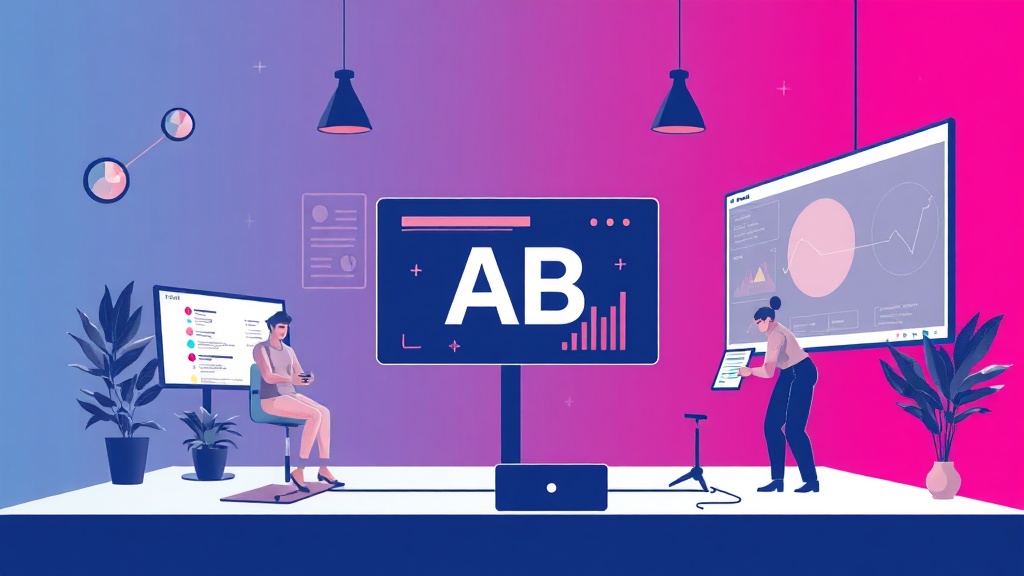
A good experimentation program values learning velocity and decision quality over the number of wins.
Document hypotheses, results, and learnings so future teams avoid repeating mistakes and can build on insights.
Experimentation is a process, not a tool
Start small, instrument carefully, and iterate. With clear hypotheses, disciplined analysis, and attention to technical detail, A/B testing becomes a powerful engine for continuous improvement across marketing, product, and UX.
